
Key Points
- A custom industrial control panel begins with a design phase that defines the electrical requirements, components, enclosure rating, and compliance obligations that every subsequent decision depends on.
- The build phase turns approved drawings into a finished assembly through component mounting, disciplined wiring, labeling, and inspection and testing, before the panel ships.
- Cost is driven chiefly by component content, enclosure type, engineering effort, wiring complexity, compliance requirements, and production volume, all of which can be managed through early planning.
Every automated production line, packaging machine, pump station, and process system depends on a control panel to start, stop, monitor, and protect the equipment around it. Standardized panels can serve simple applications, but most industrial equipment calls for something built to fit: a specific combination of voltages, loads, inputs and outputs, operator controls, and environmental conditions. That is the role of the custom industrial control panel.
For engineers, OEMs, and procurement teams, the harder question is usually not whether a custom panel is needed, but what the project will involve. This article covers what goes into the design, how the panel is built, and what determines the final cost. At EEEA, our experienced team builds control panels as part of our broader contract electronics manufacturing operation, and the sections below reflect how we work through these projects with our clients.
What Is an Industrial Control Panel?
The National Electrical Code (NEC) defines an industrial control panel as any assembly containing at least two power circuit or control circuit components, or a mix of both.1 In practical terms, it houses the devices that distribute power to equipment and direct how that equipment behaves.
Common components include:
- Power distribution: Main disconnects, circuit breakers, fuses, and power supplies bring incoming power into the panel and divide it safely among circuits.
- Motor control: Contactors, starters, overload relays, and variable frequency drives (“VFDs”) start, stop, and regulate motors.
- Logic and control: Programmable logic controllers (“PLCs”), relays, timers, and I/O modules carry out the control sequence.
- Operator interface: Push buttons, selector switches, pilot lights, and touchscreen human-machine interfaces (“HMIs”) allow personnel to monitor and command the system.
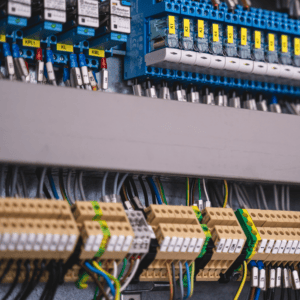
- Interconnection: Terminal blocks, DIN rail, and wire duct organize the connections between the panel and the sensors, motors, and devices it controls.
Many panels also incorporate purpose-built electronics, such as a dedicated control board or signal conditioning circuitry, produced through printed circuit board assembly and installed as a subassembly.
The Design Phase: Where Performance and Cost Are Set
Decisions made during design determine nearly everything that follows, including how long the panel takes to build, how reliably it performs in the field, and how much it costs. A thorough design phase typically addresses four areas.
Application Requirements
Design begins with a clear statement of what the panel must do. That includes the incoming supply voltage and phase, the loads being controlled, the number and type of inputs and outputs, communication protocols, operator controls, and safety functions such as emergency stops and interlocks. Ambiguity at this stage tends to resurface later as change orders.
Schematics, Layout, and the Bill of Materials
From those requirements, engineers produce electrical schematics, a panel layout drawing, and a bill of materials (“BOM”). The layout determines where each device sits on the backplate, how wire duct is routed, how much space is reserved for future expansion, and how heat-generating components (such as drives and power supplies) are spaced. Thermal management requires particular attention, since a panel that runs hot may need ventilation, fans, or air conditioning, each of which affects both the enclosure and the budget.
Enclosure Selection
The enclosure protects internal components from the surrounding environment, and its rating should match the conditions where the panel will be installed. In the United States, enclosure types are commonly specified using the National Electrical Manufacturers Association (NEMA) 250 standard.2 A few of the most commonly specified types include:
- NEMA 1: Indoor use in clean areas, protecting against incidental contact and falling dirt.
- NEMA 12: Indoor industrial use, adding protection against circulating dust, lint, and dripping or lightly splashing noncorrosive liquids.
- NEMA 4: Indoor or outdoor use where the panel may be exposed to rain, sleet, or hose-directed water.
- NEMA 4X: The protection of NEMA 4 plus corrosion resistance, often specified for washdown, chemical, and coastal environments.
Code and Compliance Requirements
Compliance obligations need to be identified before components are selected, because they shape component ratings and documentation from the start. In North America, UL 508A is the main standard for industrial control panel construction. Published in 2001, it was the first industry standard to cover complete control panel assemblies, and it addresses how panels are built, labeled, and tested to reduce the risk of fire, electric shock, and equipment failure.3
NEC Article 409 adds a requirement that industrial control panels be marked with a short-circuit current rating (“SCCR”), meaning the maximum fault current the assembly can safely withstand.4 Because a panel’s SCCR is generally limited by its lowest-rated power circuit component, reaching a higher rating may require different breakers, fuses, or current-limiting devices. Whether a panel must also carry a UL listing depends on the project specification, the end customer, and the local inspector, so that requirement is worth confirming early.
The Build Phase: From Backplate to Finished Panel
Once drawings and the BOM are approved, components are procured and assembly begins. Although every panel is different, the build generally includes the following stages:
- Backplate preparation: The subpanel is drilled and tapped, and DIN rail and wire duct are mounted according to the layout drawing.
- Component mounting: Breakers, drives, controllers, power supplies, and terminal blocks are installed in their designated positions.
- Wiring and routing: Conductors are cut, stripped, terminated, and routed through wire duct, with power and control wiring separated where the design calls for it.
- Door and enclosure work: Operator devices and HMIs are mounted and wired to the door, and openings are cut for ventilation or cable entry.
- Subassembly integration: Wire harnesses, cable assemblies, and circuit boards are installed and connected.
- Labeling: Wires, terminals, and devices are marked to match the schematics so installers and service technicians can trace every circuit.
Workmanship matters well beyond appearance. Organized routing and consistent terminations make inspection faster, reduce the likelihood of loose connections, and support troubleshooting years after installation. At EEEA, our IPC-certified technicians bring the same discipline to panel wiring that they apply to contract electronics assembly at the board level.
Inspection and Testing
Before a panel ships, it should be inspected and tested against its drawings. Typical steps include:
- Visual inspection: Component placement, routing, terminations, and labeling are checked against the layout and schematics.
- Continuity testing: Each conductor is verified to land exactly where the schematic says it should.
- Dielectric withstand (“hipot”) testing: Insulation integrity between circuits and ground is confirmed.
- Functional testing: The panel is powered, and its inputs, outputs, and control logic are exercised to confirm it behaves as intended.
For repeat production, a dedicated test fixture can make functional testing faster and more consistent from one unit to the next.
What Drives the Cost of a Custom Control Panel?
No two custom panels cost the same, and a reliable quote depends on the specifics of the design. Even so, a familiar set of factors accounts for most of the price. These include:
- Component content: Controllers, drives, HMIs, and safety devices often represent the largest share of a panel’s cost, and brand or specification requirements can narrow the options.
- Enclosure type and size: A stainless steel NEMA 4X enclosure costs considerably more than a painted steel NEMA 12 enclosure of similar size, and climate control adds further expense.
- Engineering and documentation: Design time, drawing packages, and revisions carry real cost, particularly on a first build.
- Wiring complexity: Labor scales with the number of devices, wires, and terminations, so a panel with a high I/O count takes longer to build than a simpler power distribution panel.
- Compliance requirements: Listing obligations and higher SCCR targets can call for different components and additional verification.
- Testing scope: A basic continuity check requires less time than full functional testing with simulated field devices.
- Production volume: Engineering and setup costs are spread across every unit, so repeat builds of a proven design typically cost less per panel than a one-off.
- Component availability: Long-lead or hard-to-source parts can extend schedules and, in some cases, prompt a redesign around available alternatives.
At EEEA, we prepare project-specific quotes based on your drawings, bill of materials, and expected quantities, and we welcome the opportunity to discuss a design before it is finalized.
Partner With EEEA for Your Next Control Panel Project
EEEA, Inc. has been a part of electronics manufacturing in South Carolina since 1974, serving aerospace, industrial, medical, automotive, textile, and utility markets. Our cabling and controls services include custom wire harnesses, control panels, and test fixtures, built alongside the board-level work that has made us a recognized name for PCBA in Simpsonville, SC.
Because we manage contract PCB assembly, harness fabrication, and panel wiring under one roof, revisions stay synchronized, and a single quality system governs the finished product. As a contract manufacturer near Greenville, SC, we support OEMs, system integrators, and equipment builders with Southeast US electronics assembly backed by ISO 9001:2015 certified processes.
If you are planning a custom industrial control panel, or a product that pairs a panel with circuit boards and cabling, contact our team to talk through your requirements and request a quote.
Frequently Asked Questions
What is the difference between UL 508 and UL 508A?
UL 508 applies to individual pieces of industrial control equipment, such as relays, starters, and controllers. UL 508A applies to the complete control panel assembly, including how those components are selected, protected, wired, and marked as a system.
Does every industrial control panel need to be UL listed?
Not necessarily. Whether a panel must carry a UL listing depends on the project specification, the end customer, and the local authority having jurisdiction. Even so, the NEC calls for industrial control panels to be marked with a short-circuit current rating, so SCCR should be addressed during design whether or not the panel will be listed.
How long does it take to build a custom control panel?
Timelines vary with panel complexity, engineering scope, and component availability. Assembly labor is usually the most predictable part of the schedule; long-lead items such as drives, controllers, and specialty enclosures more often set the pace. Complete documentation at the outset helps shorten the overall timeline.
What information is needed to quote a custom control panel?
The most accurate quotes start with electrical schematics, a bill of materials, a panel layout or mechanical drawing, the required enclosure rating, any compliance or listing requirements, testing expectations, and the anticipated quantity. If some of that information is still in development, a preliminary estimate can often be refined as the design matures.
Can a control panel include custom circuit boards?
Yes, many panels include purpose-built electronics such as control boards, interface boards, or signal conditioning circuits. Working with a manufacturer that offers both board assembly and panel builds allows those boards to be produced, tested, and integrated within a single workflow.
References
- “Article 100 & 409.22 Industrial Control Panels,” Electrical License Renewal.com, retrieved on October 19, 2026, from: https://www.electricallicenserenewal.com/Electrical-Continuing-Education-Courses/NEC-Content.php?sectionID=441.
- “NEMA Enclosure Types,” National Electrical Manufacturers Association, November 2005, https://nema.org/docs/default-source/products-document-library/nema-enclosure-types.pdf
- “Celebrating 25 Years of Industrial Control Panel Safety with UL 508A,” UL Standards and Engagement, October 2026, https://ulse.org/insight/celebrating-25-years-of-industrial-control-panel-safety-with-ul-508a/
- “New Short-Circuit Current Rating Requirements Facilitate Compliance with 110.10,” IAEI Magazine, January 2005, https://iaeimagazine.org/2005/january2005/new-short-circuit-current-rating-requirements-facilitate-compliance-with-110-10/

As EEEA’s Business Development Manager, Herman brings a uniquely versatile background spanning education, coaching, customer experience, and marketing. His career has always centered around people — helping others grow, learn, and succeed through clarity, creativity, and genuine connection. At EEEA, Herman combines strategy with storytelling, overseeing both client relationships and the company’s marketing initiatives. Whether managing projects, nurturing partnerships, or elevating brand presence, he focuses on creating meaningful experiences that reflect EEEA’s values of quality, service, and trust. Originally from Kurdistan in Northern Iraq, Herman’s journey has been defined by resilience and curiosity — qualities deeply rooted in the lessons of hard work and dedication instilled by his parents. Their example remains the cornerstone of his personal and professional values, shaping his approach to leadership and partnership every day.
