
Key Points
- ISO 9001:2015 is the international standard for quality management systems, and certification is granted only after an independent accredited registrar audits a manufacturer’s actual processes, records, and results.
- For a buyer of printed circuit board assembly (PCBA) services, the certification is important because it obligates the supplier to document, measure, trace, and correct its own work, rather than simply promise quality.
- The standard is not a product warranty, and understanding what it does and does not cover is essential to accurately evaluating a contract PCBA partner.
Nearly every electronics manufacturer lists certifications somewhere on their website. The logos accumulate on the footer of a homepage, and for a buyer comparing three or four suppliers, they tend to blur into a single undifferentiated signal of competence. That is unfortunate, because the certifications are not interchangeable, and one of them, ISO 9001:2015, carries more practical weight than many purchasers realize.
ISO 9001 is the most widely adopted management system standard in the world. It is also frequently misunderstood, sometimes described as a rubber stamp and often treated as a guarantee that nothing will ever go wrong. It is neither.
This article explains what the standard actually requires, how certification is earned and kept, and what a certified quality management system changes about the day-to-day experience of working with a supplier of contract electronics assembly services.
What Is ISO 9001:2015?
ISO 9001 is published by the International Organization for Standardization, a network of national standards bodies headquartered in Geneva. The standard specifies requirements for a quality management system, or QMS, that an organization uses to demonstrate its ability to consistently deliver products meeting customer, statutory, and regulatory requirements.1
Two features of the standard deserve emphasis.
- It is generic by design: ISO 9001 says nothing about solder alloys, reflow profiles, or acceptance criteria for a Class 3 assembly. It governs how an organization manages quality, not what its products must look like. The same standard applies to a hospital, a law firm, and a circuit board shop.
- It is the only certifiable standard in its family: The broader ISO 9000 family includes vocabulary and guidance documents, but ISO 9001 is the one an organization can be audited and registered against.
The “2015” designates the fifth edition, published that year. It reorganized the standard around ten clauses, of which seven carry substantive requirements2:
- Context of the organization
- Leadership
- Planning
- Support
- Operation
- Performance evaluation
- Improvement.
Underpinning those clauses are seven quality management principles:
- Customer focus
- Leadership
- Engagement of people
- A process approach
- Improvement
- Evidence-based decision making
- Relationship management.
The 2015 edition also introduced risk-based thinking as a structural requirement. Rather than reacting to defects after they occur, a certified organization is obligated to identify what could go wrong in each of its processes and plan accordingly. For an electronics manufacturer, that means formally accounting for risks such as component obsolescence, counterfeit parts entering the supply chain, moisture-sensitive device handling, and single-source dependencies, and documenting the controls that address them.
How Certification Is Earned
This is the part most buyers never see, and it is the reason the certification is worth something.
Certification is not self-declared. An organization seeking it engages a third-party certification body, or registrar, that is itself accredited by a national accreditation authority. The registrar conducts a two-stage initial audit: a documentation review, followed by an on-site assessment of whether the described system is genuinely in operation. Auditors examine records, interview operators, trace individual jobs through the process, and issue findings for any nonconformity.
Certification is also not permanent, but contingent on:
- Surveillance audits: The registrar returns at defined intervals, typically annually, to verify the system remains effective and that prior findings were closed.
- Recertification: The full audit cycle repeats every three years.
- Suspension and withdrawal: Certificates can be and are revoked when major nonconformities go uncorrected.
The certificate itself carries a defined scope, which is worth reading rather than assuming. EEEA’s certificate, for example, covers the manufacture and assembly of printed circuit boards at our Simpsonville, SC, facility. A scope statement tells you precisely which activities at which location the registrar assessed.
What a Certified QMS Looks Like on the Production Floor
Abstract clauses become concrete practices. In an electronics manufacturing South Carolina operation working to ISO 9001:2015, the requirements translate into the following:
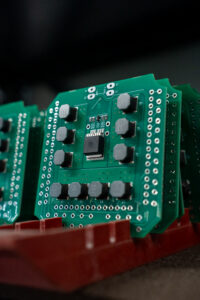
- Document control: Assembly drawings, work instructions, and bills of material exist in controlled, current revisions.
- Traceability: Records connect a finished assembly back to the component lots, the equipment, the operator, and the date of build.
- Calibration: Test equipment, inspection systems, and measurement tools are calibrated on a schedule against traceable references, and out-of-tolerance findings trigger review of the work performed since the last valid calibration.
- Supplier control: Component distributors and subcontractors are evaluated, approved, and monitored rather than selected ad hoc on price and availability.
- Nonconformance and corrective action: Defects are logged, contained, analyzed for root cause, and closed with verified corrective action. (The system distinguishes between fixing a board and fixing the process that produced it.)
- Internal audit and management review: The organization audits itself between registrar visits, and senior leadership formally reviews quality performance against objectives.
What certification adds is the obligation to perform requisite tasks consistently and to prove it to an outside party who has no commercial stake in the answer.
Why It Matters to You
For the purchasing engineer or program manager sourcing contract electronic assembly work, ISO 9001:2015 certification changes the character of the relationship in several practical ways.
- It shifts the burden of proof: An uncertified supplier asks you to trust its description of its processes. A certified supplier has already had that description tested by an accredited auditor, at its own expense, on a recurring basis.
- It simplifies your own supplier qualification: Many buyers operate under quality systems that require them to qualify and periodically re-evaluate their suppliers. A current ISO 9001 certificate satisfies a substantial portion of that obligation and shortens the approval cycle considerably.
- It supports your regulatory and contractual position: Aerospace, defense, medical, and utility customers pass quality requirements down through their supply chains. Sourcing from a certified manufacturer helps you meet those flow-down obligations.
- It makes problems recoverable: When something does go wrong, the traceability and corrective action requirements mean the supplier can tell you what happened, which units are affected, and what has changed to prevent recurrence.
- It reduces the total cost of quality: Scrap, rework, retest, and field returns are expensive for the customer as well as the manufacturer. A functioning QMS is fundamentally a mechanism for finding defects early, when they are cheap.
How ISO 9001 Relates to IPC and Sector Standards
ISO 9001 governs the management system. It does not define workmanship. In electronics, that gap is filled by the IPC standards, which specify acceptability criteria for bare boards, soldered assemblies, and cable and wire harnesses, along with the requirements for soldered electrical and electronic assemblies.3 A manufacturer with certified technicians working to those standards has objective, published criteria for what constitutes an acceptable joint, rather than an internal opinion.
The two frameworks are complementary and best understood as a pair:
- ISO 9001 answers: Is the organization managing its processes in a controlled, measurable, improving way?
- IPC standards answer: Does this specific assembly meet the industry’s published workmanship criteria for its class?
Sector-specific quality standards, including AS9100 for aerospace and ISO 13485 for medical devices, are built directly on the ISO 9001 framework and add requirements particular to those industries. A supplier already operating a mature ISO 9001 system is positioned to extend into those standards rather than build a quality system from nothing.
What the Certification Does Not Promise
Honest evaluation requires acknowledging the limits. Here are some things ISO 9001 certification does not cover:
- It is not a product guarantee: ISO 9001 certifies a system, not an individual assembly. A certified manufacturer can still ship a defective board; the standard obligates it to detect, document, and correct the failure.
- It is not a capability statement: Certification says nothing about whether a supplier has the equipment, component sourcing depth, or engineering support your particular project requires.
- It is not uniformly implemented: Systems vary in maturity. Therefore, it is reasonable to request the certificate and check its scope and expiration, ask how nonconformances are tracked, and ask to see a sample traveler or process map.
A supplier confident in its system will happily answer these questions.
A Note on the Coming Revision
ISO periodically reviews its standards, and the sixth edition of ISO 9001 is scheduled for publication in September 2026. The revision is widely characterized as evolutionary rather than structural, retaining the existing clause architecture while sharpening the treatment of risk, organizational culture, and climate-related considerations. Certified organizations are expected to receive a multi-year transition period.
For buyers, the practical implication is straightforward: an ISO 9001:2015 certificate remains fully valid, and a supplier with a mature 2015 system is well positioned to transition. Certification obtained today is not work that will be discarded.
Working With a Certified Partner
EEEA, Inc. has provided contract PCB assembly, custom cabling, and electromechanical assembly services from Simpsonville, South Carolina since 1974. We are ISO 9001:2015 certified for the manufacture and assembly of printed circuit boards, our technicians are IPC certified, and our inspection process pairs automated optical inspection with documented in-process and final verification.
If you are evaluating PCBA suppliers in the Greenville, SC, area and want to see what a certified quality system looks like in practice, we would welcome the conversation. Ask us for our certificate, ask how we handle a nonconformance, and ask to walk the floor. Those are the right questions, and we are glad to answer them.
Frequently Asked Questions
Is ISO 9001:2015 certification required to perform contract PCB assembly work?
No, certification is voluntary. It becomes effectively mandatory, however, when your end customer or your own quality system requires certified suppliers, which is common in aerospace, defense, medical, and utility applications.
How can I verify that a manufacturer’s certificate is current?
Ask for a copy. A legitimate certificate names the registrar, the accreditation body, the certified location, the scope of activities, and the expiration date. Most registrars also maintain a public directory that allows independent confirmation.
Does certification mean every board will be defect-free?
Not quite. It means the manufacturer maintains audited processes for preventing, detecting, and correcting defects, and that it can trace an issue to its source. Certification is a statement about process discipline rather than an outcome warranty.
What is the difference between ISO 9001 certification and IPC certification?
ISO 9001 certifies an organization’s quality management system through an accredited third-party registrar. IPC certification applies to individuals, meaning technicians and inspectors trained and tested against the industry’s workmanship standards. A strong contract electronics assembly partner will hold both.
Should I be concerned that ISO 9001:2015 is being revised?
No, existing certificates remain valid, and certified organizations receive a transition period to adopt the new edition. The revision refines the current framework rather than replacing it.
References
- “ISO 9001 Explained,” International Organization for Standardization, retrieved on August 27, 2026, from: https://www.iso.org/home/insights-news/resources/iso-9001-explained.html
- Srđan Medić*, Biljana Karlović, and Zrinko Cindrić, “New Standard ISO 9001:2015 and its Effect on Organisations,” Interdisciplinary Description of Complex Systems, March 2016, https://www.researchgate.net/publication/299336399_New_Standard_ISO_90012015_and_its_Effect_on_Organisations
- “IPC Standards,” Globe Electronics Association, retrieved on August 26, 2026, from: https://www.electronics.org/ipc-standards.

Originally from Pittsburgh, Pennsylvania, Aaron brings a deep and diverse background in quality and production to EEEA, Inc. After earning his degree from Georgia Tech, he built a career that spans both large-scale corporations — including DuPont, Shaw Flooring, and Johnson & Johnson — and innovative startups like MycoWorks. His expertise in quality systems, engineering, and process improvement helps ensure EEEA continues to meet the highest standards of precision and performance. Aaron enjoys the close-knit, collaborative nature of a smaller company, where communication is open, decisions move quickly, and every team member makes a visible impact.