
Key Points
- Custom wire harnesses and control panel assemblies need to be inspected and tested to the same quality standards as printed circuit board assembly work, so every interconnect in a finished product meets a consistent bar for performance and safety.
- Sourcing wire harnesses, point-to-point wiring, control panel assembly, and PCB assembly from a single electronics manufacturing partner simplifies procurement, reduces vendor overhead, and keeps quality standards consistent across every component of a build.
- EEEA’s cabling and controls capabilities cover the full production lifecycle, from design support and fabrication through crimping, soldering, continuity and hipot testing, and final integration with PCBA subassemblies.
The Overlooked Backbone of Every Electronic System
Printed circuit boards (PCB) tend to get the credit for making electronic products work. But no board—however well designed—functions in isolation.
Power has to reach it. Signals have to travel to and from sensors, displays, motors, and switches. Enclosures and control panels have to be wired correctly, safely, and in a way that holds up to vibration, heat, moisture, and years of use in the field. That connective layer, built from wire harnesses, point-to-point wiring, and control panel assemblies, is what turns a functioning board into a functioning product.
At EEEA, cabling and control assembly are treated with the same engineering discipline applied to board-level work. Every harness is built to a defined specification. Every termination is inspected. Every completed assembly is tested before it ships. That consistency matters because a product is only as reliable as its weakest connection (and in many designs, that weak point is not the board itself but the wiring around it).
What Falls Under Cabling and Control Assembly Services
Cabling and controls work covers a broad range of interconnect and panel-level tasks, most of which are easy to overlook until something fails in the field. A capable manufacturing partner should be able to support all of the following under one roof.
- Custom wire harness design support and fabrication
- Point-to-point wiring for chassis and enclosure builds
- Control panel assembly and wiring
- Cable assembly, including shielded and specialty cables
- Crimping, soldering, and terminal installation
- Continuity and high-potential (hipot) testing
- Labeling, routing, and strain relief
- Integration with printed circuit board assembly subassemblies
Custom Wire Harness Design Support and Fabrication
A wire harness bundles multiple wires, connectors, and terminals into a single organized assembly, engineered to route power and signal through a specific product enclosure without the tangle of loose, unprotected wiring. Getting a harness right requires more than tying wires together.1 Conductor gauge has to be matched to current load, connector selection has to account for the mating hardware on both ends, and routing must anticipate how the harness will be installed, serviced, and flexed over the life of the product.
Point-to-Point Wiring for Chassis and Enclosure Builds
Not every interconnect fits neatly into a pre-built harness. Chassis and enclosure builds often require point-to-point wiring, where individual conductors are run and terminated directly between components inside the finished product. This approach is common in control cabinets, industrial equipment, and custom enclosures, where layout is dictated by the mechanical design rather than a standardized harness footprint. Point-to-point work demands close attention to wire routing, labeling, and strain relief, since there is no harness jacket to keep conductors organized and protected.
Control Panel Assembly and Wiring
Control panels are the interface between a piece of equipment and the people who operate it, and they typically combine multiple disciplines: switches and indicators, terminal blocks, relays, circuit protection, and often a PCB or controller mounted within the same enclosure. Building a control panel correctly means wiring all of these elements to schematic, labeling every connection for traceability, and confirming that the finished panel meets relevant safety and electrical standards before it is released.
Cable Assembly, Including Shielded and Specialty Cables
Cable assemblies, distinct from wire harnesses, generally involve a smaller number of conductors terminated with connectors on one or both ends, often used to link subassemblies or connect a product to external equipment. Many applications require shielded cable to reduce electromagnetic interference, or specialty cable types built to withstand extreme temperatures, flexing, or exposure to chemicals and moisture. Selecting and assembling the right cable type is part of ensuring the finished product performs reliably in its intended environment.
Crimping, Soldering, and Terminal Installation
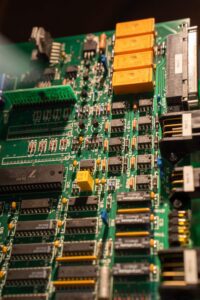 The quality of a wire harness or cable assembly comes down to its terminations. Crimped connections must be applied with calibrated tooling to achieve consistent pull strength and electrical contact. Soldered joints must be formed to workmanship standards that avoid cold joints, bridging, or thermal damage to adjacent components. Terminal installation—whether ring terminals, spade connectors, or pin and socket contacts—has to match the application’s current rating and mechanical requirements. These are foundational skills, but they are also where a large share of field failures originate when not executed to relevant standards.
Continuity and High-Potential (Hipot) Testing
No harness, cable, or control panel should leave a production floor untested. Continuity testing confirms that every intended connection is present and that no unintended shorts exist between conductors. High-potential, or hipot, testing applies a controlled high voltage between conductors and ground to verify that insulation is intact and that the assembly can safely withstand the electrical stresses it will encounter in service. Together, these tests catch defects that visual inspection alone would miss.
Labeling, Routing, and Strain Relief
The details that make an assembly serviceable over its lifetime are often the ones easiest to skip. Clear labeling at each termination point supports troubleshooting and field repair. Routing that keeps conductors away from heat sources, moving parts, and sharp edges prevents premature wear.
Strain relief at connector interfaces and panel entry points keeps repeated flexing or vibration from working a wire loose or fatiguing it to failure.2 These finishing steps are what separate an assembly built to last from one that looks correct on day one but fails within a year.
The Advantage of an Integrated Contract Electronics Assembly Partner
Cabling and control assembly rarely exist in isolation from the rest of a product’s electronics. Most designs that require custom wire harnesses or control panels also require printed circuit board assembly, and increasingly, original equipment manufacturers are looking for a single partner that can deliver both. Sourcing harnesses from one vendor, control panels from another, and PCB assembly from a third introduces coordination overhead, inconsistent quality standards, and additional points of failure at every handoff.
An integrated model, where cabling and controls are delivered as part of a broader contract electronics assembly portfolio, addresses this directly. When one manufacturer builds the board, wires the harness, and assembles the control panel, quality standards stay consistent across every component, and the finished electromechanical subassembly can be tested as a complete unit rather than as disconnected parts. This is particularly valuable for OEMs whose enclosures combine electronic, electrical, and electromechanical elements, where the interaction between the board and the wiring around it directly affects how the finished product performs.
Choosing a Cabling and Controls Partner in South Carolina
For OEMs looking for electronics manufacturing in South Carolina, the case for an integrated partner comes down to accountability. A single manufacturer responsible for both the board and the wiring around it has no ambiguity about where a failure originated, and no incentive to point to another vendor’s work. EEEA has built its reputation for the highest standards of quality, and extends that same inspection and testing discipline to the cabling and control assemblies that connect its boards to the rest of a client’s product.
For manufacturers looking to consolidate suppliers, reduce lead time variability, and hold every interconnect to a documented standard, that combination of board-level expertise and cabling and controls capability under one roof is difficult to replicate by piecing together separate vendors. Contact us today to learn more about our services or to schedule a consultation.
Frequently Asked Questions
What is the difference between a wire harness and a cable assembly?
A wire harness typically bundles multiple wires into a single organized assembly with branching connections designed to route through a specific product layout. A cable assembly usually involves a smaller number of conductors terminated with connectors, often used to link two points or two subassemblies rather than distributing power and signal throughout an entire enclosure.
Why does hipot testing matter for a wire harness or control panel?
Hipot testing applies a controlled high voltage to verify that insulation between conductors and ground can safely withstand the electrical stresses the assembly will face in service. It catches insulation defects that would not be visible through a standard continuity check, which is why it is treated as a required step rather than an optional one.
Can control panel assembly be combined with printed circuit board assembly in a single order?
Yes, many products combine a control panel with an internal PCB, and building both under one partner allows the two to be engineered, tested, and integrated together rather than coordinated across separate vendors.
What industries typically require custom wire harnesses and control panel assembly?
Industrial equipment, medical devices, test and measurement systems, and other applications that combine electronic, electrical, and electromechanical components in a single enclosure commonly require both custom wiring and control panel work.
Does EEEA provide design support for a wire harness, or only fabrication?
Design support is available alongside fabrication, including reviewing a customer’s schematic or existing assembly to confirm wire gauge, connector selection, and routing before production begins.
References
- Cicerone Laurentiu Popa, Costel Emil Cotet, Ana Maria Ifrim, et al., “Optimization of Wiring Harness Logistics Flow in the Automotive Industry,” Applied Sciences, November 2024, https://www.mdpi.com/2076-3417/14/22/10636.
- “Back to Basics Sept/Oct 2020 – Strain Relief,” Wiring Harness News, September 2020, https://wiringharnessnews.com/back-to-basics-sept-oct-2020-strain-relief/.

As EEEA’s Business Development Manager, Herman brings a uniquely versatile background spanning education, coaching, customer experience, and marketing. His career has always centered around people — helping others grow, learn, and succeed through clarity, creativity, and genuine connection. At EEEA, Herman combines strategy with storytelling, overseeing both client relationships and the company’s marketing initiatives. Whether managing projects, nurturing partnerships, or elevating brand presence, he focuses on creating meaningful experiences that reflect EEEA’s values of quality, service, and trust. Originally from Kurdistan in Northern Iraq, Herman’s journey has been defined by resilience and curiosity — qualities deeply rooted in the lessons of hard work and dedication instilled by his parents. Their example remains the cornerstone of his personal and professional values, shaping his approach to leadership and partnership every day.
